
Currently Empty: $0.00


Excavation Productivity and Cycle Time on Construction Jobsites
Excavation sits at the start of nearly every construction project. Foundations, utility trenches, basements, drainage systems, and site grading all depend on moving soil efficiently and accurately. When excavation runs on schedule, the trades that follow can start on time. When it falls behind, delays ripple through the entire project, raising costs and compressing the time available for everything that comes after.
Productivity in excavation comes down to how efficiently equipment removes, moves, and places material through hundreds or even thousands of repeated work cycles. A few seconds saved on each cycle can add up to hours over a full shift and days over a large project. A few seconds lost to poor positioning, waiting trucks, or an unsuitable bucket add up just as quickly in the other direction.
Cycle time is one of the most useful ways to understand that performance. It shows how long each sequence of digging, lifting, swinging, dumping, and returning takes to complete, and it reveals where time is being gained or lost. This guide covers what excavation cycle time is and how soil conditions affect digging resistance. It also explains how machine positioning and working range shape each cycle, how to match bucket size to the material, how to coordinate trucks and supporting equipment, and how to track performance and reduce delays. When contractors understand these factors and apply them without compromising safety, excavation becomes faster, more predictable, and more cost-effective.
Coordinating Trucks and Supporting Equipment
An excavator can only work as fast as the system around it allows. Even the most efficient digging cycle comes to a stop when there is no truck to load, no space to place spoil, or no clear route for material to leave the site. On many jobsites, the biggest productivity losses come not from the excavator itself but from waiting for supporting equipment.
Balancing the fleet is the first step. Compare the time it takes to load one truck with the time it takes that truck to haul, dump, and return. The number of trucks should allow a loaded truck to leave as an empty truck arrives, so the excavator keeps working without long pauses. As haul distances change during the project, the fleet may need to be adjusted.
Truck positioning at the loading point has a direct effect on cycle time. Establish a clear loading position that keeps the swing short and gives the operator a good view into the truck body. Where space allows, a double-sided loading arrangement lets one truck pull in on one side while another is being loaded on the other side, reducing the gap between trucks. Clear markers or a spotter can help drivers position quickly and consistently.
Haul routes deserve the same attention as the excavation itself. Keep routes graded, drained, and wide enough for safe passage. Where trucks must pass each other, provide designated passing points. Maintain the disposal or placement area so trucks can unload quickly, and use supporting equipment such as dozers or loaders to spread and manage material there.
Safety must remain central to every coordination effort. Workers on foot and other equipment should stay outside the excavator’s swing radius at all times. Truck drivers should follow site rules for staying in or leaving the cab during loading, and the excavator should never swing a loaded bucket over a truck cab or over any person. Establish clear communication methods, such as hand signals, radio calls, or horn signals, and make sure every operator and driver understands them before work begins. Keep pedestrian routes separated from haul traffic wherever practical.
Key takeaway: Balance the truck fleet to the loading cycle, set up efficient loading positions, maintain haul routes and dumping areas, and keep people and equipment outside the swing radius with clear site communication.
Matching Bucket Size to Ground Conditions

Selecting the right mini excavator bucket starts with understanding the material being excavated. Dense clay, sandy fill, fractured rock, and hard ground place different demands on the bucket and machine. Compare soil conditions with the bucket’s design, capacity, tooth configuration, and the manufacturer’s recommendations to determine which attachment suits the task.
Bucket size also affects machine loading and excavation efficiency. A wider bucket may move more material per pass in suitable soil, while a narrower, heavy-duty bucket with appropriate teeth can be better suited to confined cuts or tougher ground. However, increasing bucket capacity can also increase the load carried by the excavator, especially when handling dense or wet material. Stay within the machine’s rated lifting and operating limits, and verify that the quick coupler is securely locked before digging.
Production depends on more than bucket capacity alone. Consider the truck body size, material density, required load, digging depth, and available working space when choosing a bucket. Avoid overfilling the bucket or exceeding the truck’s rated payload, and adjust the loading approach to suit the material and site conditions.
Key takeaway: Match bucket design and capacity to ground conditions, material density, and machine limits to support efficient excavation without overloading equipment.
Machine Positioning and Working Range
Where the machine stands has a major effect on how efficiently it works. A well-positioned excavator can dig, lift, swing, and dump with smooth, compact movements. A poorly positioned machine may need wide swings, awkward boom angles, repeated travel, or frequent repositioning, all of which add time to every cycle.
Every excavator has a working range defined by its maximum digging depth, reach, digging height, and dumping height. The outer edges of that range are where the machine has the least leverage and the least control. Digging force often drops at full extension, and small control movements create larger bucket movements, making accurate work harder. The most productive zone is usually the middle of the working range, where the boom and arm can work together to pull the bucket through the soil with strong force and good control.
Swing angle is one of the most important positioning factors. The farther the machine must rotate between the dig point and the dump point, the longer each cycle takes. Placing trucks or spoil piles so the machine swings through a smaller angle can save meaningful time on every load. A swing of roughly a quarter turn is generally much faster than a half turn, and the savings multiply across a full shift.
Dumping height matters as well. When loading trucks, the machine must lift the bucket high enough to clear the side of the truck body. If the truck sits on the same level as the excavator, the boom must rise further on each cycle. Where site conditions allow, positioning the excavator on a stable bench above the truck can shorten lift time and improve visibility into the truck body.
Key takeaway: Position the machine so it works in the middle of its range with a short swing and an efficient dumping height, reposition deliberately rather than overreaching, and always keep it on stable ground within its approved limits.
Coordinating Trucks and Supporting Equipment
Efficient excavation relies on coordinating the excavator, haul trucks, and supporting machinery throughout the loading cycle. Plan truck arrival and departure times around the excavator’s digging rate and the capacity of each truck. A balanced workflow reduces unnecessary waiting, prevents congestion around the loading area, and helps maintain consistent material movement.
Haul routes should remain graded, clear, and suitable for the weight and traffic of the equipment using them. Inspect for potholes, loose material, standing water, and restricted turning areas, and provide enough room for trucks to enter, position themselves, and depart safely. Supporting equipment, such as a dozer, can help maintain the loading area and keep disposal zones organized.
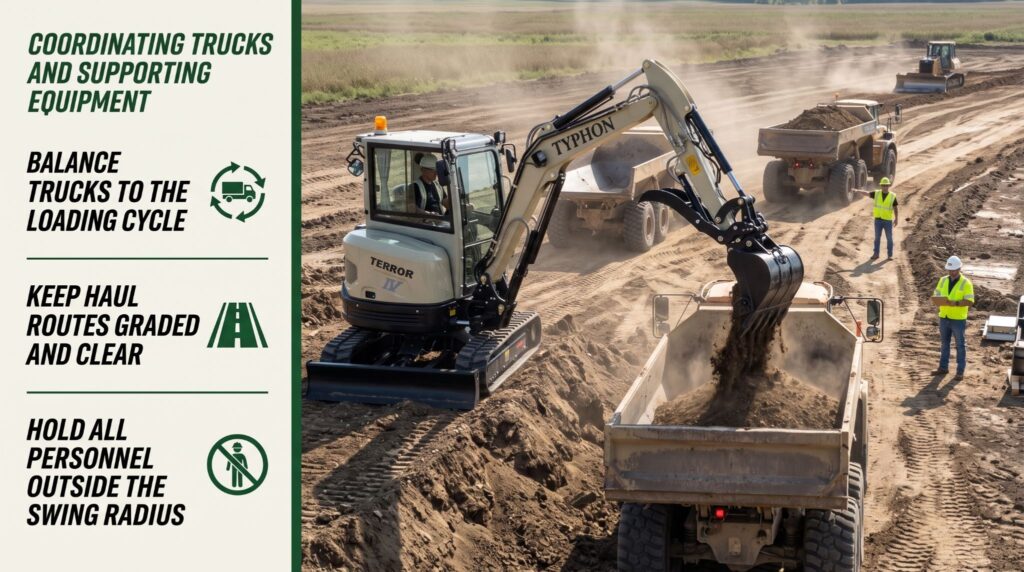
Personnel management is essential when excavators and trucks operate together. Establish clear communication between operators and spotters, define truck positioning procedures, and keep all workers outside the excavator’s swing radius and other equipment movement zones. Stop operations if visibility is lost or a person enters a restricted area.
Key takeaway: Coordinate truck capacity, arrival timing, haul route conditions, and supporting equipment while maintaining clear exclusion zones to improve workflow and reduce site hazards.
Bucket Size and Material Handling
Bucket size determines how much material moves with each cycle, which makes it one of the most direct influences on production. A larger bucket carries more material per load, so it seems logical that bigger always means faster. In practice, the relationship is more complicated.
A larger bucket is heavier and holds more material, which increases the total weight the machine must lift and swing. In light, loose material, that extra capacity can raise production significantly. In dense or wet material, the same bucket may become too heavy when full, slowing the hydraulic functions, reducing stability, and pushing the machine toward or beyond its rated limits. A wider bucket also meets more resistance in hard ground, which can slow penetration and leave the bucket only partly filled on each pass.
Several factors determine whether a bucket is the right match:
- Material density: Wet clay, gravel, crushed stone, and broken concrete weigh far more than dry topsoil for the same volume.
- Digging resistance: Hard or compacted material may fill a smaller bucket more completely and more quickly.
- Machine capacity: The loaded bucket must stay within the machine’s rated lifting and operating limits.
- Trench or excavation width: The bucket must suit the required dimensions without overdigging.
- Dumping space and truck size: The bucket should load the truck body evenly and efficiently without spilling over the sides.
Bucket fill is just as important as bucket size. A large bucket that only fills halfway on each pass may move less material than a smaller bucket that fills completely. Operators can improve fill by keeping the teeth at an angle that lets them bite into the material, drawing the bucket smoothly through the cut, and curling it at the right moment to capture a full load. Sticky material that clings to the bucket reduces effective capacity, so cleaning the bucket when buildup occurs helps maintain real output.
Matching the bucket to the truck also affects overall productivity. Ideally, the truck should fill in a whole number of passes, with the final pass topping off the load rather than leaving the truck noticeably under capacity or requiring a partial bucket. Underloaded trucks waste haul trips, while overloaded trucks can exceed their rated limits and spill material on haul routes.
Material handling technique ties these factors together. Smooth, controlled movements keep material in the bucket during the swing and place it evenly in the truck. Lowering the bucket close to the truck body before releasing the load reduces impact, protects the truck, and limits spillage. Spreading each load evenly helps keep the truck balanced and makes full use of its capacity.
Key takeaway: A larger bucket does not always increase production, so match bucket size to material density, digging resistance, machine capacity, and truck size, and focus on full, controlled loads with every pass.
Tracking Performance and Reducing Delays
Productivity improves fastest when contractors measure it. Without data, it can be difficult to tell whether a crew is working efficiently or whether hidden delays are slowing production. Tracking cycle times and output gives a clear, objective picture of how the job is progressing and where attention is needed.
Start by measuring cycle times on representative work. Time a series of cycles for each machine and task, and note the duration of individual stages where practical. Record the conditions at the same time, including soil type, moisture, bucket size, swing angle, and truck availability. Many modern machines include onboard systems that can track operating hours, fuel use, idle time, and sometimes payload or cycle counts. Where these tools are available, they can make tracking easier and more consistent.
Idle time deserves particular attention. A machine running without moving material uses fuel, accumulates hours, and adds wear without adding production. Tracking idle time often reveals coordination gaps that are easier to solve than mechanical issues.
Regular maintenance supports consistent performance. Inspect the machine before every shift with it parked on firm, level ground, the bucket lowered, and the engine off. Check teeth and cutting edges, pins and bushings, hydraulic hoses and cylinders, tracks or tires, and the attachment coupler. Never check for hydraulic leaks by running your hand along a hose, since pressurized fluid can penetrate skin and cause serious injury. Use a piece of cardboard instead. Report defects and keep the machine out of service until they are corrected. A well-maintained machine responds smoothly and keeps cycle times steady throughout the day.
Organized work zones also help. Clearly marked dig areas, spoil locations, truck routes, and exclusion zones reduce confusion and allow each machine to work in a predictable pattern. Review the layout as the excavation progresses, since a setup that worked well early in the job may need to change as the hole grows and haul routes shift.
Use the data to make practical decisions. Short daily or weekly reviews can help crews adjust truck counts, bucket choices, setup positions, and work sequences. Share results with operators and drivers, since the people doing the work often have the clearest view of what is slowing them down. Improvements should always be measured against safety. Any change that shortens cycle time but increases risk is not a true improvement.
Key takeaway: Measure cycle times and conditions, compare similar tasks to find recurring delays, reduce idle time, maintain equipment consistently, and use the results to make practical changes that keep the work both productive and safe.
Conclusion
Excavation productivity depends on how well every part of the work cycle fits together. Cycle time provides a clear measure of performance, and breaking it into stages shows exactly where time is gained or lost. Soil conditions and digging resistance shape how quickly the bucket can fill, so matching equipment and methods to the material keeps the machine working efficiently instead of struggling. Thoughtful machine positioning keeps the work in the middle of the working range with short swings and efficient dumping heights, while the right bucket size balances load volume with material density, machine capacity, and truck size. Coordinated trucks, well-maintained haul routes, and organized dumping areas keep the excavator from waiting, and consistent performance tracking reveals the delays that might otherwise go unnoticed. When contractors plan each setup carefully, measure results, maintain equipment, and keep safe operating limits and ground conditions as firm priorities, excavation moves forward at a steady, dependable pace that keeps the entire project on schedule.
FAQs
What is an excavation cycle?
An excavation cycle is the repeated sequence of movements a machine performs to move one load of material. For an excavator, it typically includes bucket penetration, filling, lifting, swinging, dumping, and returning to the digging position.
Does a larger bucket always reduce cycle time?
No. A larger bucket may increase load weight and digging resistance, slow hydraulic functions, and push the machine toward its rated limits. The best bucket is the one that matches the material density, digging conditions, machine capacity, and truck size.
How can contractors reduce excavation delays?
Improve machine positioning to shorten swings, balance the truck fleet with the loading cycle, set up efficient truck loading positions, maintain haul routes and dumping areas, keep equipment well maintained, and organize clear work zones.
Why should productivity measurements account for soil conditions?
Different materials create different levels of digging resistance, and moisture can change how soil fills and releases from the bucket. Recording soil conditions alongside cycle times allows fair comparisons and helps identify whether delays come from the material or from other factors.
How does swing angle affect productivity?
A wider swing between the dig point and the dump point adds time to every cycle. Positioning trucks and spoil areas closer to the dig face and within a shorter swing can save significant time over a full shift.
